Abstract
The development of functional knitted materials for cosmetological and post-surgical applications requires a comprehensive assessment of their technological, structural, and hygienic characteristics. This study investigates six variants of knitted fabrics intended for the manufacture of cosmetological compression mask products. The experimental materials were evaluated according to surface density, thickness, air permeability, moisture absorption, and volumetric density. These indicators are particularly important for mask products intended to maintain contact with the facial skin, provide controlled compression, preserve dimensional stability, and ensure an acceptable level of physiological comfort. The experimental results demonstrated considerable differences among the six variants. Surface density ranged from 379.5 to 661.8 g/m2, thickness from 1.20 to 2.20 mm, air permeability from 17.43 to 65.4 cm3/(cm2·s), moisture absorption from 5.9 to 11.8%, and volumetric density from 205.2 to 413.6 mg/cm3. The results demonstrate that structural parameters of knitted fabrics significantly affect the functional performance of cosmetological mask materials. Variants with lower thickness and higher air permeability may provide improved physiological comfort, whereas materials with higher surface and volumetric density can provide a more compact structure and potentially greater mechanical stability. The obtained data can be used for selecting rational knitted structures for cosmetological compression masks and for further development of functional medical and cosmetological textile products.
Keywords
Knitted Fabric, Cosmetological Mask, Compression Textile, Surface Density, Thickness, Air Permeability,
Moisture Absorption, Volumetric Density
1. Introduction
The development of functional textile materials for medical, therapeutic, and cosmetological applications is an important direction of modern textile engineering. Knitted materials are particularly suitable for such applications because their looped structure provides high extensibility, flexibility, conformability, and the ability to adapt to complex body contours. These characteristics are especially important for products designed for the human face, where the material must closely follow anatomical contours while maintaining comfortable contact with the skin
| [1] | Isachenko V. P., Osipova V. A., Sukomel A. S. Heat Transfer: Textbook for Universities. - Moscow: Energia, 1975. |
| [2] | Ormseth B. H., Livermore N. R., Schoenbrunner A. R., Janis J. E. The Use of Postoperative Compression Garments in Plastic Surgery—A Practical Review. Plast Reconstr Surg Glob Open, 2023. https://pmc.ncbi.nlm.nih.gov/articles/PMC10519563/ |
| [3] | Anand S. C., Horrocks A. R. Handbook of Technical Textiles. Woodhead Publishing, 2016.
https://www.sciencedirect.com/book/9781782424581/handbook-of-technical-textiles |
| [4] | Das A., Alagirusamy R. Science in Clothing Comfort. Woodhead Publishing, 2010.
https://www.sciencedirect.com/book/9781845695392/science-in-clothing-comfort |
| [5] | Spencer, D. J. Knitting Technology: A Comprehensive Handbook and Practical Guide. 3rd ed. Cambridge: Woodhead Publishing, 2001. |
[1-5]
.
Cosmetological compression masks represent a specialized type of functional textile product. Such products can be designed for use during postoperative rehabilitation and for various cosmetological procedures in which controlled mechanical support and fixation of facial tissues are required. In addition to compression performance, the textile material should provide sufficient air exchange and moisture management because prolonged contact between the product and the skin can affect physiological comfort.
The functional performance of a knitted mask is determined by a combination of structural and technological parameters. Surface density and thickness characterize the material's mass and geometric structure, while air permeability and moisture absorption are important indicators of hygienic and physiological properties. Volumetric density, in turn, provides additional information about the compactness of the knitted structure
| [5] | Spencer, D. J. Knitting Technology: A Comprehensive Handbook and Practical Guide. 3rd ed. Cambridge: Woodhead Publishing, 2001. |
| [6] | Saville, B. P. Physical Testing of Textiles. Cambridge: Woodhead Publishing, 1999. |
| [7] | Munden, D. L. The Geometry and Dimensional Properties of Plain-Knit Fabrics. Journal of the Textile Institute, 1959, Vol. 50, No. 7, pp. T448-T471. |
| [8] | ISO 9237: 1995. Textiles — Determination of the permeability of fabrics to air. Geneva: International Organization for Standardization, 1995. |
| [9] | ISO 6330: 2021. Textiles — Domestic washing and drying procedures for textile testing. Geneva: International Organization for Standardization, 2021. |
| [10] | ISO 139: 2005. Textiles — Standard atmospheres for conditioning and testing. Geneva: International Organization for Standardization, 2005. |
[5-10]
.
The relationship between these characteristics is complex. Increasing the compactness of a knitted structure can increase surface and volumetric density while simultaneously reducing the amount of air passing through the material. Conversely, a more open structure can improve air permeability but may have lower surface density and mechanical stability. Therefore, the selection of a knitted fabric for cosmetological compression applications requires consideration of several properties simultaneously rather than relying on a single indicator.
| [11] | Study on the three-dimensional modeling of the geometric shape and trochoidal motion trajectory of rotary tillage blades. Biosystems Engineering, 2004, 89(1), 47-58.
https://doi.org/10.1016/j.biosystemseng.2004.05.011 |
| [12] | Design and experimental study of a disc cultivator for primary inter-row tillage of potatoes. 2020, 51(8), 98-108.
https://doi.org/10.6041/j.issn.1000-1298.2020.08.011 |
| [13] | Li, Y., Zhou, W., Sun, Z., Chen, T., et al. Analysis and experimental study of the working process of the soil-engaging disc of a potato cultivator. INMATEH Agricultural Engineering, 2022. https://doi.org/10.35633/inmateh-67-35 |
| [14] | Pervushin, V. F., Salimzyanov, M. Z., Casimov, N. G., Shmykov, S. N., Costin, A. V. Justification of the parameters and operating modes of a rotary cultivator for potato crops. Journal of Agriculture and Horticulture Research, 2026, 9(2), 1-11. |
| [15] | Simulation and Experimental Study of Rotary Tillage Blades. Agriculture Journal, 2023. |
[11-15]
.
The objective of the present study was to comparatively evaluate six variants of knitted fabrics intended for cosmetological compression mask products and to identify the differences in their principal technological and hygienic characteristics.
2. Materials and Methods
Six variants of knitted fabric intended for cosmetological mask products were investigated. The samples were evaluated using five principal indicators:
1) surface density, g/m2;
2) thickness, mm;
3) air permeability, cm3/(cm2·s);
4) moisture absorption,%;
5) volumetric density, mg/cm3.
These indicators were selected because they provide complementary information concerning the mass, geometric structure, permeability, moisture interaction, and compactness of the knitted material.
Surface density is an important technological characteristic because it reflects the mass of fabric per unit area. For a cosmetological compression mask, surface density is associated with the amount of textile material used in the product and can also influence its handling, drape, and structural stability.
Thickness characterizes the distance between the two surfaces of the textile material. In facial compression products, thickness can affect the ability of the material to conform to facial contours and may influence thermal and tactile comfort.
Air permeability characterizes the ability of air to pass through the knitted structure. This property is particularly important for products that remain in direct contact with the skin for extended periods. Adequate air exchange can contribute to improved physiological comfort.
Moisture absorption characterizes the ability of the textile material to interact with and retain moisture. For cosmetological mask products, this parameter is important because perspiration and moisture accumulation can influence the sensation of comfort during use.
Volumetric density is associated with the compactness of the textile structure and is related to the relationship between mass and thickness. Together with surface density and thickness, this parameter provides a more complete characterization of the spatial structure of the knitted material.
3. Experimental Results
The experimental results for all six variants are presented in
Table 1.
Table 1. Technological and hygienic characteristics of knitted fabric for cosmetological mask products.
Indicator | Unit | Variant 1 | Variant 2 | Variant 3 | Variant 4 | Variant 5 | Variant 6 |
Surface density | g/m2 | 451.6 | 430.9 | 392.5 | 661.8 | 661.3 | 379.5 |
Thickness | mm | 2.2 | 1.8 | 1.25 | 1.6 | 1.65 | 1.2 |
Air permeability | cm3/(cm2·s) | 48.3 | 65.4 | 26.5 | 17.43 | 31.4 | 61.9 |
Moisture absorption | % | 7.21 | 5.9 | 6.4 | 11.8 | 11.3 | 9.63 |
Volumetric density | mg/cm3 | 205.2 | 239.3 | 314 | 413.6 | 400.7 | 316.2 |
The results demonstrate substantial variation in all investigated properties. Such differences indicate that the structural characteristics of the knitted materials have a pronounced effect on their functional performance.
3.1. Surface Density
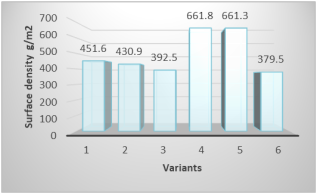
The surface density of the investigated fabrics ranged from 379.5 to 661.8 g/m2. The minimum value was recorded for Variant 6, at 379.5 g/m2, whereas the maximum value was observed for Variant 4, at 661.8 g/m2. Variant 5 had a very similar value of 661.3 g/m2.
Figure 1. Surface density diagram of cosmetological compression masks.
The difference between the minimum and maximum surface density is considerable. The maximum value is approximately 74% higher than the minimum value. This indicates that the variants differ substantially in the amount of textile material contained in a unit area.
Variants 4 and 5 are characterized by the highest surface density. Such materials have a greater mass per unit area and consequently a more material-intensive structure. This characteristic may be associated with increased structural compactness and mechanical stability; however, a higher surface density should be considered together with permeability and thickness when selecting a material for facial applications.
Variant 6, in contrast, combines the lowest surface density with relatively high air permeability and the lowest thickness among the investigated samples. This combination indicates a comparatively less massive and more permeable structure.
3.2. Thickness
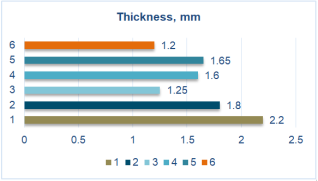
The thickness values varied from 1.20 to 2.20 mm. The greatest thickness was observed in Variant 1, with a value of 2.20 mm, while the smallest value was recorded for Variant 6, at 1.20 mm.
Variants 2 and 4 had thickness values of 1.80 and 1.60 mm, respectively, whereas Variants 3 and 5 demonstrated values of 1.25 and 1.65 mm.
The differences in thickness are important for cosmetological mask applications because a thinner textile may conform more easily to facial contours and may be perceived as less bulky. However, thickness cannot be evaluated independently of the other characteristics.
Figure 2. Thickness diagram of cosmetological compression masks.
For example, Variant 1 has the greatest thickness but only an intermediate surface density, whereas Variant 4 has a substantially greater surface density but a lower thickness.
This observation demonstrates that surface density and thickness are controlled not only by the total amount of material but also by the spatial arrangement and compactness of the knitted structure.
3.3. Air Permeability
Air permeability demonstrated particularly significant variation among the samples. Values ranged from 17.43 to 65.4 cm3/(cm2·s).
The highest air permeability was obtained for Variant 2, at 65.4 cm3/(cm2·s), followed closely by Variant 6, at 61.9 cm3/(cm2·s). Variant 1 showed a value of 48.3 cm3/(cm2·s), while Variant 3 had 26.5 cm3/(cm2·s).
The lowest air permeability was recorded for Variant 4, at 17.43 cm3/(cm2·s). Variant 5 also demonstrated relatively low permeability, at 31.4 cm3/(cm2·s).
The results suggest an association between structural compactness and air permeability. Variants 4 and 5, which have the highest surface densities and volumetric densities, demonstrate comparatively low air permeability. In contrast, Variants 2 and 6 have relatively high air permeability.
For cosmetological mask products, air permeability is an important physiological characteristic because the product is intended to remain in direct contact with facial skin. Higher air permeability may facilitate air exchange through the textile and contribute to improved wearing comfort.
4. Discussion
The comparative analysis demonstrates that the six knitted fabric variants possess distinctly different combinations of technological and hygienic properties. This is important for the development of cosmetological compression masks because the required material characteristics depend on the intended function of the product.
A cosmetological compression mask should provide sufficient structural stability while maintaining flexibility and physiological comfort. High surface density and volumetric density may contribute to a compact textile structure, but excessive compactness can be accompanied by reduced air permeability. This relationship is clearly demonstrated by Variants 4 and 5, which have the highest surface densities and relatively low air permeability.
Conversely, Variants 2 and 6 demonstrate substantially higher air permeability. Variant 2 has the highest air permeability of all samples, while Variant 6 combines high air permeability with the lowest thickness and lowest surface density.
From a technological perspective, these results indicate that the structure of the knitted fabric can be used to regulate the balance between material consumption, thickness, compactness, and permeability. This is particularly relevant when designing products that must combine compression with comfort.
The results also demonstrate that no single indicator can fully characterize the suitability of a knitted fabric for cosmetological applications. For example, a high surface density may indicate increased material consumption, but it does not automatically imply improved functional performance. Similarly, high air permeability is beneficial for physiological comfort but should be considered alongside mechanical and dimensional requirements.
Therefore, the selection of a rational knitted structure should be based on a comprehensive evaluation of surface density, thickness, air permeability, moisture absorption, volumetric density, and, in further studies, elastic and compression properties.
5. Conclusions
The experimental investigation of six knitted fabric variants intended for cosmetological compression masks led to the following conclusions:
1) Significant differences were established in the technological and hygienic characteristics of the investigated knitted fabrics.
2) Surface density ranged from 379.5 to 661.8 g/m2, with the highest values recorded for Variants 4 and 5 and the lowest value for Variant 6.
3) Fabric thickness varied from 1.20 to 2.20 mm. Variant 1 had the greatest thickness, while Variant 6 had the smallest.
4) Air permeability ranged from 17.43 to 65.4 cm3/(cm2·s). The highest value was obtained for Variant 2, whereas the lowest value was observed for Variant 4.
5) Moisture absorption ranged from 5.9 to 11.8%, with the maximum value recorded for Variant 4.
6) Volumetric density varied between 205.2 and 413.6 mg/cm3. The highest value was observed for Variant 4 and the lowest for Variant 1.
7) The samples with higher surface and volumetric density generally demonstrated lower air permeability, indicating a relationship between structural compactness and air exchange.
8) Variant 6 demonstrated a combination of relatively low surface density (379.5 g/m2), low thickness (1.20 mm), high air permeability (61.9 cm3/(cm2·s)), and comparatively high moisture absorption (9.63%). This combination identifies it as a useful subject for further investigation of lightweight and breathable cosmetological mask materials, while final selection should also consider compression, elasticity, recovery, and skin-contact performance.
The obtained results demonstrate the potential for regulating the functional characteristics of knitted materials through structural design. Further research should focus on the relationship between these technological parameters and the compression pressure, elastic recovery, dimensional stability, and repeated deformation resistance of finished cosmetological mask products.
Author Contributions
Mukhtarova Nargiza: Methodology, Project administration, Resources, Software, Supervision, Validation, Visualization, Writing – original draft, Writing – review & editing
Khankhadjaeva Nilufar: Conceptualization, Data curation, Formal Analysis, Funding acquisition, Investigation, Methodology, Project administration, Resources, Supervision, Validation, Writing – review & editing
Conflicts of Interest
The authors declare no conflicts of interest.
References
| [1] |
Isachenko V. P., Osipova V. A., Sukomel A. S. Heat Transfer: Textbook for Universities. - Moscow: Energia, 1975.
|
| [2] |
Ormseth B. H., Livermore N. R., Schoenbrunner A. R., Janis J. E. The Use of Postoperative Compression Garments in Plastic Surgery—A Practical Review. Plast Reconstr Surg Glob Open, 2023.
https://pmc.ncbi.nlm.nih.gov/articles/PMC10519563/
|
| [3] |
Anand S. C., Horrocks A. R. Handbook of Technical Textiles. Woodhead Publishing, 2016.
https://www.sciencedirect.com/book/9781782424581/handbook-of-technical-textiles
|
| [4] |
Das A., Alagirusamy R. Science in Clothing Comfort. Woodhead Publishing, 2010.
https://www.sciencedirect.com/book/9781845695392/science-in-clothing-comfort
|
| [5] |
Spencer, D. J. Knitting Technology: A Comprehensive Handbook and Practical Guide. 3rd ed. Cambridge: Woodhead Publishing, 2001.
|
| [6] |
Saville, B. P. Physical Testing of Textiles. Cambridge: Woodhead Publishing, 1999.
|
| [7] |
Munden, D. L. The Geometry and Dimensional Properties of Plain-Knit Fabrics. Journal of the Textile Institute, 1959, Vol. 50, No. 7, pp. T448-T471.
|
| [8] |
ISO 9237: 1995. Textiles — Determination of the permeability of fabrics to air. Geneva: International Organization for Standardization, 1995.
|
| [9] |
ISO 6330: 2021. Textiles — Domestic washing and drying procedures for textile testing. Geneva: International Organization for Standardization, 2021.
|
| [10] |
ISO 139: 2005. Textiles — Standard atmospheres for conditioning and testing. Geneva: International Organization for Standardization, 2005.
|
| [11] |
Study on the three-dimensional modeling of the geometric shape and trochoidal motion trajectory of rotary tillage blades. Biosystems Engineering, 2004, 89(1), 47-58.
https://doi.org/10.1016/j.biosystemseng.2004.05.011
|
| [12] |
Design and experimental study of a disc cultivator for primary inter-row tillage of potatoes. 2020, 51(8), 98-108.
https://doi.org/10.6041/j.issn.1000-1298.2020.08.011
|
| [13] |
Li, Y., Zhou, W., Sun, Z., Chen, T., et al. Analysis and experimental study of the working process of the soil-engaging disc of a potato cultivator. INMATEH Agricultural Engineering, 2022.
https://doi.org/10.35633/inmateh-67-35
|
| [14] |
Pervushin, V. F., Salimzyanov, M. Z., Casimov, N. G., Shmykov, S. N., Costin, A. V. Justification of the parameters and operating modes of a rotary cultivator for potato crops. Journal of Agriculture and Horticulture Research, 2026, 9(2), 1-11.
|
| [15] |
Simulation and Experimental Study of Rotary Tillage Blades. Agriculture Journal, 2023.
|
Cite This Article
-
APA Style
Nargiza, M., Nilufar, K. (2026). Technological and Hygienic Characteristics of Knitted Fabrics for Cosmetological Compression Masks. American Journal of Mechanics and Applications, 13(4), 72-76. https://doi.org/10.11648/j.ajma.20261304.13
 Copy
|
 Download
ACS Style
Nargiza, M.; Nilufar, K. Technological and Hygienic Characteristics of Knitted Fabrics for Cosmetological Compression Masks. Am. J. Mech. Appl. 2026, 13(4), 72-76. doi: 10.11648/j.ajma.20261304.13
Copy
|
Download
AMA Style
Nargiza M, Nilufar K. Technological and Hygienic Characteristics of Knitted Fabrics for Cosmetological Compression Masks. Am J Mech Appl. 2026;13(4):72-76. doi: 10.11648/j.ajma.20261304.13
Copy
|
Download
-
@article{10.11648/j.ajma.20261304.13,
  author = {Mukhtarova Nargiza and Khankhadjaeva Nilufar},
  title = {Technological and Hygienic Characteristics of Knitted Fabrics for Cosmetological Compression Masks},
  journal = {American Journal of Mechanics and Applications},
  volume = {13},
  number = {4},
  pages = {72-76},
  doi = {10.11648/j.ajma.20261304.13},
  url = {https://doi.org/10.11648/j.ajma.20261304.13},
  eprint = {https://article.sciencepublishinggroup.com/pdf/10.11648.j.ajma.20261304.13},
  abstract = {The development of functional knitted materials for cosmetological and post-surgical applications requires a comprehensive assessment of their technological, structural, and hygienic characteristics. This study investigates six variants of knitted fabrics intended for the manufacture of cosmetological compression mask products. The experimental materials were evaluated according to surface density, thickness, air permeability, moisture absorption, and volumetric density. These indicators are particularly important for mask products intended to maintain contact with the facial skin, provide controlled compression, preserve dimensional stability, and ensure an acceptable level of physiological comfort. The experimental results demonstrated considerable differences among the six variants. Surface density ranged from 379.5 to 661.8 g/m2, thickness from 1.20 to 2.20 mm, air permeability from 17.43 to 65.4 cm3/(cm2·s), moisture absorption from 5.9 to 11.8%, and volumetric density from 205.2 to 413.6 mg/cm3. The results demonstrate that structural parameters of knitted fabrics significantly affect the functional performance of cosmetological mask materials. Variants with lower thickness and higher air permeability may provide improved physiological comfort, whereas materials with higher surface and volumetric density can provide a more compact structure and potentially greater mechanical stability. The obtained data can be used for selecting rational knitted structures for cosmetological compression masks and for further development of functional medical and cosmetological textile products.},
 year = {2026}
}
Copy
|
Download
-
TY  - JOUR
T1  - Technological and Hygienic Characteristics of Knitted Fabrics for Cosmetological Compression Masks
AU  - Mukhtarova Nargiza
AU  - Khankhadjaeva Nilufar
Y1  - 2026/10/20
PY  - 2026
N1  - https://doi.org/10.11648/j.ajma.20261304.13
DO  - 10.11648/j.ajma.20261304.13
T2  - American Journal of Mechanics and Applications
JF  - American Journal of Mechanics and Applications
JO  - American Journal of Mechanics and Applications
SP  - 72
EP  - 76
PB  - Science Publishing Group
SN  - 2376-6131
UR  - https://doi.org/10.11648/j.ajma.20261304.13
AB  - The development of functional knitted materials for cosmetological and post-surgical applications requires a comprehensive assessment of their technological, structural, and hygienic characteristics. This study investigates six variants of knitted fabrics intended for the manufacture of cosmetological compression mask products. The experimental materials were evaluated according to surface density, thickness, air permeability, moisture absorption, and volumetric density. These indicators are particularly important for mask products intended to maintain contact with the facial skin, provide controlled compression, preserve dimensional stability, and ensure an acceptable level of physiological comfort. The experimental results demonstrated considerable differences among the six variants. Surface density ranged from 379.5 to 661.8 g/m2, thickness from 1.20 to 2.20 mm, air permeability from 17.43 to 65.4 cm3/(cm2·s), moisture absorption from 5.9 to 11.8%, and volumetric density from 205.2 to 413.6 mg/cm3. The results demonstrate that structural parameters of knitted fabrics significantly affect the functional performance of cosmetological mask materials. Variants with lower thickness and higher air permeability may provide improved physiological comfort, whereas materials with higher surface and volumetric density can provide a more compact structure and potentially greater mechanical stability. The obtained data can be used for selecting rational knitted structures for cosmetological compression masks and for further development of functional medical and cosmetological textile products.
VL  - 13
IS  - 4
ER  -
Copy
|
Download







 Share This Article
 Twitter
 Linked In
 Facebook